Why Your Breakout Trades Keep Failing (And How Acceptance Fixes It)

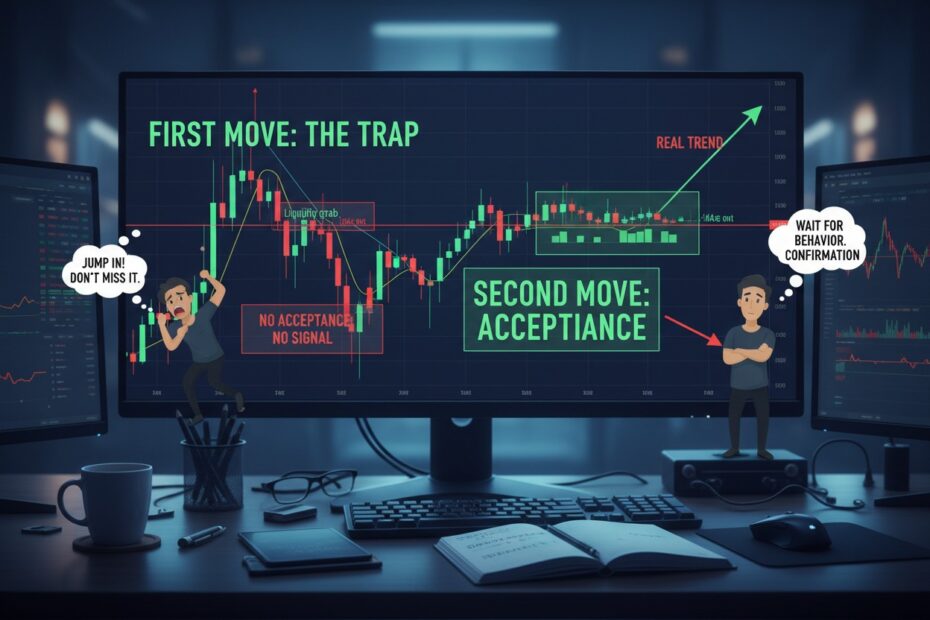
Price hits a key level. It snaps back hard. Traders lean in and think, “That’s it. Direction confirmed.”
It isn’t. Not yet.
That first move? It’s often a trap dressed up as clarity.
Why the First Reaction Fools Everyone
Levels attract orders. That’s it. That’s the whole secret.
Stops get triggered. Positions open and close in a rush. Price whips around because liquidity got hit — not because the market made a decision.
Activity isn’t commitment. Remember that.
Real commitment shows up later, in a completely different phase: acceptance.
What Acceptance Actually Looks Like
Acceptance happens when price refuses to leave.
Instead of reversing, it holds. It consolidates. It pulls back a little, shrugs, and keeps grinding in the same direction. That’s the market telling you something real: buyers or sellers are comfortable transacting here. This isn’t a fluke — it’s agreement.
No acceptance? No real signal. Just noise pretending to be a trend.
A sharp rejection followed by hesitation isn’t strength. It’s an imbalance that already burned itself out. Traders who jump in on that first spike are often stepping directly into the market’s next move — the wrong way.
The First Move Informs. The Second Move Confirms.
Here’s the shift that changes everything:
Stop asking, “What will this level do?” Start asking, “How is price behaving after touching it?”
The level was never the signal. The behavior around it is.
This single distinction is what separates traders who wait with intention from traders who react on impulse.
Why Everyone Rushes In Anyway
Pressure. Plain and simple.
When price hammers a major support or resistance zone, the urge to jump the gun is real. Nobody wants to miss “the move.” So traders start trading their expectations instead of the evidence in front of them.
And the market punishes that, consistently.
Real trends aren’t born from one big candle. They’re built on sustained participation. If buyers genuinely control a breakout, price stays above the level even after the initial excitement fades. Pullbacks stay shallow. Sellers can’t reclaim lost ground. Continuation happens naturally, without a fight.
Flip it for breakdowns. Same rules apply.
When Acceptance Never Comes
Sometimes the market shows its hand fast.
Price slides back into the old range. Momentum dries up. Breakout traders are suddenly underwater and trapped. And here’s the kicker, these failed breakouts often spark the sharpest reversals, because everyone trapped on the wrong side has to unwind at once.
That’s not bad luck. That’s structure playing out exactly as it should.
Excitement Fades. Stability Tells the Truth.
A blazing green candle grabs attention. But it doesn’t prove anything.
A market that quietly holds above resistance, without the fireworks, is often far stronger than one that explodes through it. One is emotion. The other is agreement. And agreement is what moves markets long-term.
How This Changes the Way You Read Levels
Support and resistance aren’t tripwires. They’re decision zones.
The market arrives, and then it decides. Your job isn’t to predict that decision, it’s to read it once the market shows you.
What happens after the level matters more than the level itself. Always.
The Payoff: Better Entries, Fewer Traps
Wait for acceptance, and something changes in your trading.
You stop entering during chaos. You stop getting caught in liquidity grabs and fake-outs. You take fewer trades, but the ones you take actually mean something.
Less noise. More signal. Fewer regrets.
The Bottom Line
Anyone can spot a reaction. It’s loud, it’s fast, and it feels like an opportunity.
Few traders have the patience to wait and see if the market actually accepts it.
That patience? That’s the edge.
Enjoyed this breakdown? Share it with a trader who still chases every breakout.